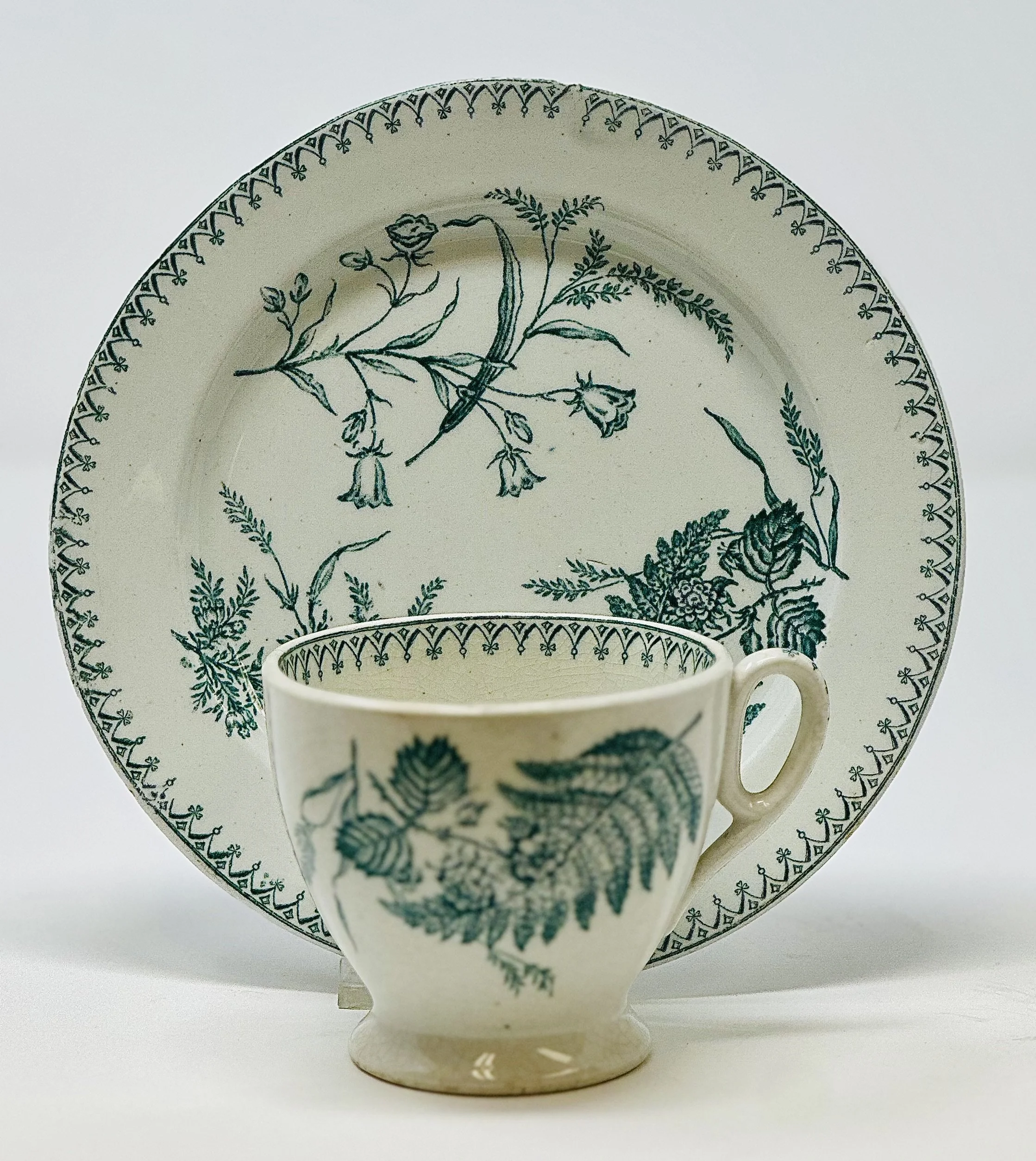
Daniel Webster and Sandwich
What do these ordinary dishes have to do with one of the most famous American statesmen of the nineteenth century?
According to Museum records, they were used by Daniel Webster (1782–1852) at his home in Marshfield, Massachusetts. Their simple naturalistic decoration offers a glimpse of the private life behind a man who was a national celebrity; a renowned lawyer, orator, senator, and Secretary of State whose powerful arguments for the Constitution and the Union earned him the title “Defender of the Constitution.”
Webster also had a personal connection to Sandwich. Beginning at least as early as 1820, he and his wife Grace regularly spent time here with friends, while Webster hunted the marshes and fished the trout streams of Sandwich and neighboring Mashpee. His letters document repeated visits, including a memorable 1825 excursion when he caught 26 trout in a single day. Local tradition also closely associated him with the Fessenden Tavern on Main Street, later the Central House and renamed the Dan’l Webster Inn in 1915.
The cup and plate were donated to the Sandwich Historical Society in 1914 by Melissa Thurston Ellis, a former Boston & Sandwich Glass Company worker who later served as Curator of the Historical Society from 1919 to 1928. Her gift reflects the work of an earlier generation that recognized how even ordinary objects could preserve Sandwich’s connections to the larger American story.
Webster’s national legacy is complex. He opposed the extension of slavery into new territories, but in 1850 supported a compromise intended to preserve the Union that included a strengthened Fugitive Slave Act—reflecting the deepening divisions over slavery that would ultimately lead to the Civil War.
As we mark America’s 250th anniversary, this cup and plate connect national history with local memory, reminding us that what communities choose to preserve helps determine which stories are remembered.