
& Historical Society
The bark Ocean · 1859–1861
This website is part of an experiment in how AI can help us learn about the collections of the Sandwich Glass Museum & Historical Society and explore local history. It is being developed from an AI-assisted transcription. A human reviewer still needs to verify the transcript against the original logbook. Dates, names, quotations, and figures may change as that review proceeds; the material presented here is provisional.
The Ocean
and its many stories
The logbook of the bark Ocean, 1859–1861
What was it like to spend months at sea searching for whales? A handwritten logbook in the Sandwich Glass Museum & Historical Society's collection offers a window into the daily work, weather, and encounters of a nineteenth-century whaling voyage.
The journal follows the work of sailing, hunting, and processing whales, alongside storms, visits to island ports, and encounters with other ships. An AI-assisted transcription helps us explore those entries — while keeping uncertain readings and gaps in view.
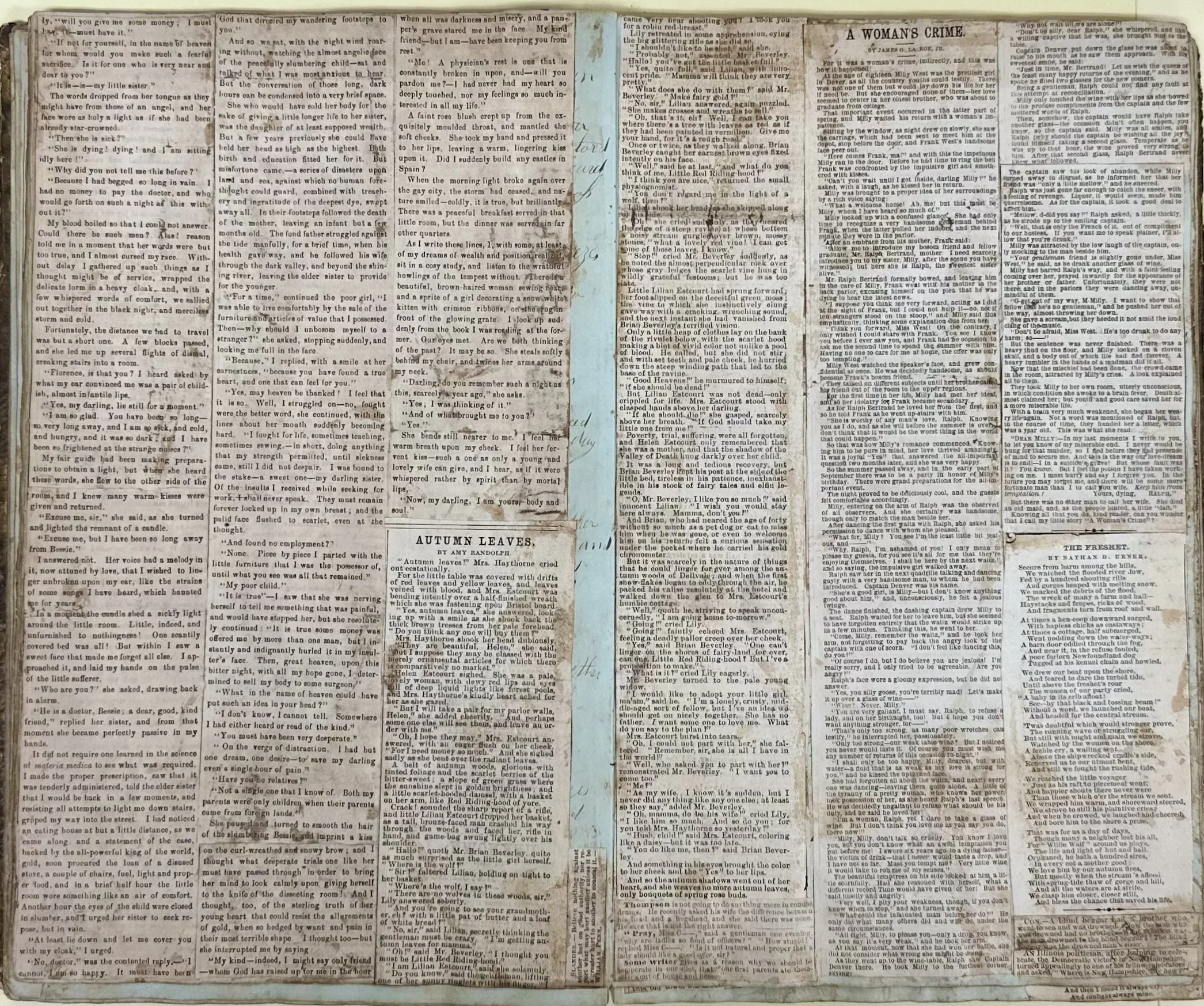
The logbook also had a second life as a scrapbook. Newspaper articles were pasted over many of its handwritten pages, obscuring portions of the original record and leaving gaps in what we can read today.
The transcription covers photographed portions of the volume, including material beyond the voyage journal. The four anchorages below are selected documented stops, not a complete itinerary. Voyage entries run from September 12, 1859 to August 24, 1861; the final entry does not record arrival home.
A second life as a scrapbook
This open spread shows newspaper clippings pasted across both pages, concealing much of the earlier handwriting. Narrow strips of blue paper and handwritten text remain visible between the clippings. Printed stories and poems sit alongside one another, showing how the volume was reused.
This spread alone does not establish who pasted in the clippings or when the volume became a scrapbook.
A voyage told in daily details
A seasick crew at the start. A whale brought alongside. A sail on the horizon carrying news. Read the dated voyage outline, follow the work of whaling, or turn to the unexpected finds tucked among the daily remarks.
These selections come from the reading transcription. Select an IMG reference to open the corresponding manuscript photograph in Google Drive. Human verification of the transcription against the original logbook is still required.
Following the Ocean
The entries identify anchorages in the Caribbean, the Azores, and the Canary Islands. A sighting of land is distinguished here from an arrival in port; these dated points do not establish the ship’s complete track.
Leaving the pilot
The opening entry records leaving the pilot at two o’clock, stowing cables, and clearing up. Most of the hands were seasick.
Journal reference: IMG_1035.
Flores comes into view
The island of Flores was sighted at noon, with humpbacks and finbacks also reported. This entry records a sighting, not an anchorage.
Journal reference: IMG_1054.
At anchor in Faial, Azores, Portugal
The journal places the ship at anchor at “Fayal” (modern Faial, an island in the Azores, Portugal) on September 15. The crew helped tow another ship off the rocks, discharged about 100 barrels of oil on September 17, and spent subsequent days painting and taking turns ashore. The Ocean departed on October 2.
Water and provisions at Gran Canaria
After sighting the peak of Tenerife, the ship anchored at “Grand Canary” on October 22. Water came aboard in casks; the October 23 entry records 100 barrels. Heavy surf delayed a watch’s return from shore, and an attempted departure on October 27 ended with anchoring again. The ship got under way on October 29.
Bound home
A late-July page is headed “Bound home.” The August entries still record gales, damaged sails, and hunting. On August 21 and 22 the crew sounded the depth with a lead line. The last transcribed voyage entry, August 24, describes a dead calm; it does not establish the date or port of arrival.
Putting the voyage on a map
This first reconstruction combines selected named stops in the museum journal with three provisional position readings from the Cornell companion journal at Providence Public Library. It is a map of evidence, not a complete sailing track. Named places are plotted approximately; their dots are not navigational fixes.
| Point | Date | Place | Source and limits |
|---|---|---|---|
| 1 | 1860-02-05 | Barbados anchorage | Museum journal IMG_1050 named place; approximate map location |
| 2 | 1860-02-12 | Dominica anchorage | Museum journal IMG_1051 island/harbor identification; approximate location |
| 3 | 1860-07-18 | Eclipse-day position | Cornell companion journal · PPL manuscript p.54 / PDF p.58 provisional coordinate reading: 45°54′ N, 28°25′ W |
| 4 | 1860-07-22 | North Atlantic position | Cornell companion journal · PPL manuscript p.55 / PDF p.59 provisional coordinate reading: 46°10′ N, 25°15′ W |
| 5 | 1860-07-24 | North Atlantic position | Cornell companion journal · PPL manuscript p.55 / PDF p.59 provisional coordinate reading: 45°58′ N, 24°22′ W |
| 6 | 1860-09-15 | Faial anchorage, Azores, Portugal | Museum journal IMG_1072 named anchorage; approximate map location |
| 7 | 1860-10-22 | Gran Canaria anchorage | Museum journal IMG_1076 named island/anchorage; approximate location |
The Whaling History track-data query for voyage AV10715 returned no positions during this investigation. A daily track must therefore be transcribed and checked from the companion manuscripts before we can draw it. Lines between the selected points would conceal long gaps, so none are drawn. Coastline: Natural Earth. Download the selected locations and source labels.
An eclipse at sea
“At 12 sun in an eclipse.”
Among sightings of sails and grampuses, the museum journal records a solar eclipse. Its reading transcription places the observation on July 18, 1860, during a day beginning with light winds and fog.
Open the museum’s original page photograph. Quotation and date are from the museum reading transcription, still awaiting human verification.
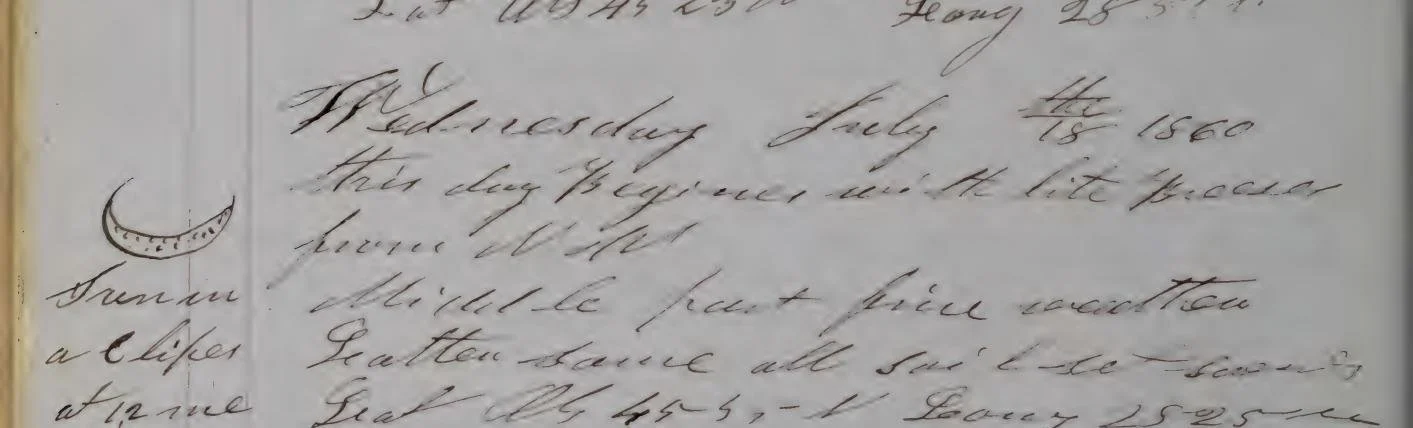
Would an eclipse have been visible there?
Cornell companion journal · PPL The position line is provisionally read as 45°54′ N, 28°25′ W. These coordinates come from the companion volume, not from the museum entry.
NASA eclipse predictions NASA confirms a total solar eclipse on July 18, 1860. Its narrow totality corridor crossed the Atlantic well north of the ship’s provisionally read position. Greatest eclipse occurred at approximately 14:26 UT, near 52°29′ N, 20°21′ W; that is the eclipse’s global reference point, not the Ocean’s location. NASA path table.
New calculation · provisional A sea-level estimate using NASA’s Besselian elements and Cornell’s position predicts a partial eclipse, with about 70–75% of the Sun’s area covered at maximum, around 14:23 UT (about 12:30 local mean time at that longitude). This percentage is calculated here; neither journal gives it. The museum’s brief noon observation is compatible with an eclipse in progress, but does not describe its maximum or quantify how much of the Sun was covered.
What the eclipse can—and cannot—check
A correctly dated astronomical event gives a useful check on the transcription and on whether a proposed location is plausible. But a partial eclipse could be seen across a broad region, so this short entry cannot confirm a precise latitude or longitude. “At 12” is shipboard time, not UT; apparent versus mean time, the position’s observation time, movement of the ship, clouds, and manuscript-reading errors all affect comparison. The crescent is an illustration, not a calibrated measurement of obscuration.
The calculation uses the NASA elements for July 18, 1860, ΔT = 7.7 seconds, an oblate Earth, and a stationary observer at sea level. A check at NASA’s greatest-eclipse position returns totality; varying the ship position by ±1° changes the estimated maximum area coverage to approximately 69–78%. This is a first-pass consistency check, not an independently certified ephemeris result. NASA elements; calculation results and sensitivity estimates.
Before and after this voyage
External ship history · not a journal entry L. Vernon Briggs’s History of Shipbuilding on North River (1889), p.111, identifies the Ocean as a 165-ton brig built in 1839, with Elijah Barstow Jr. as master carpenter. It describes service as a Boston–Baltimore packet, entry into the Sandwich whaling fleet in 1851, a change of rig to a bark in 1856, sale to Sag Harbor in 1864, and loss in 1867.
1839 Built as a brig at Hanover, Massachusetts.
Before 1851 Packet service between Boston and Baltimore.
1851 Joined the Sandwich whaling fleet.
1856 Rerigged as a bark.
1859–1861 The voyage documented in the museum book and companion journals.
1864 Sold to Sag Harbor.
1867 Reported lost; circumstances remain to be investigated.
Sources: Briggs (1889), p.111; Whaling History vessel AS2074. The vessel database independently identifies Hanover, 1839, and loss in 1867; its voyage records show the change from brig to bark and later Sag Harbor service. These identifiers distinguish this hull from other vessels named Ocean. The biography is a source-based outline, not a complete account of the ship’s ownership or loss.
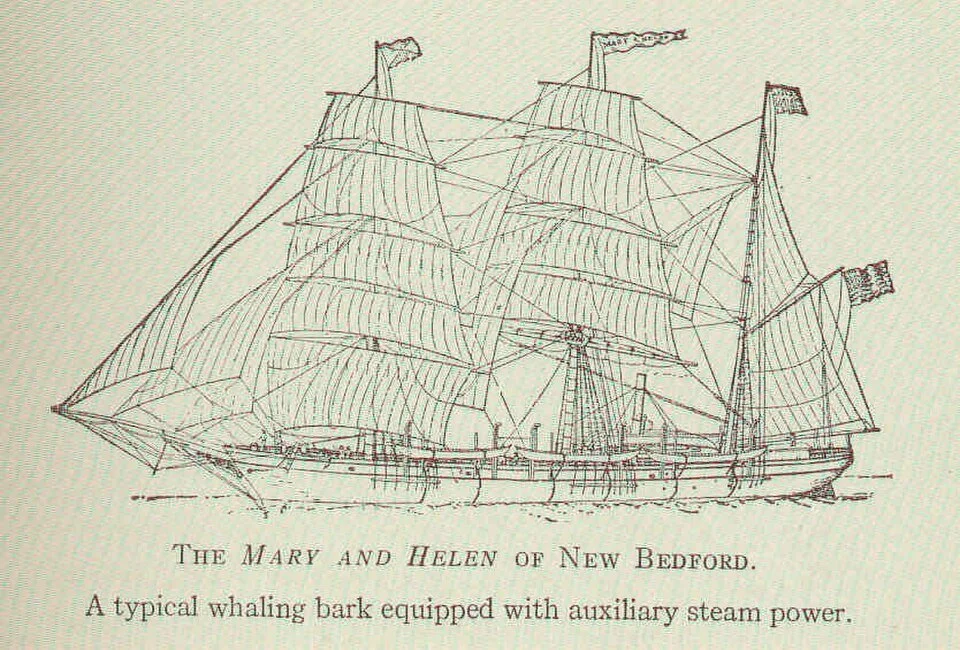
A whaling bark under sail. The Mary and Helen of New Bedford illustrates the bark rig: square sails on the forward two masts and fore-and-aft sails on the aftermost mast. It helps us picture the general arrangement of a whaling bark, but represents a later vessel equipped with auxiliary steam power. It is not an exact reconstruction of the Ocean during the 1859–1861 voyage.
Published in A. Hyatt Verrill, The Real Story of the Whaler (1916), p.55. Public domain. Credit: University of Washington Libraries, Freshwater and Marine Image Bank, image 44667, via Wikimedia Commons.
Returning to a country at war
Tripp companion journal · NBWM The third mate’s journal ends with a reference to Buzzards Bay on August 26, 1861 (PDF p.134). Museum journal The available museum voyage entries end on August 24 without recording arrival. Historical context Fighting at Fort Sumter began April 12, 1861, more than four months before the ship’s return. This places the homecoming in wartime, but does not establish what the crew knew or how they reacted. Tripp journal; Library of Congress context.
Companion accounts of the voyage
Two digitized volumes offer companion accounts of the Ocean’s 1859–1861 voyage: a journal cataloged as kept by Peleg Cornell, at Providence Public Library, and a log/journal cataloged as kept by third mate William Tripp, at the New Bedford Whaling Museum. Their latitude and longitude entries can help place the museum journal’s events at sea, while their accounts of whale encounters, damaged sails, and meetings with other vessels add detail and allow us to compare dates. For example, Tripp records the prolonged whale chase and cutting loose at midnight under June 21, agreeing with the museum transcription’s date; the comparable incident appears under June 22 in the Cornell volume. Other details and dates also differ. These books provide parallel evidence, not replacement text for the museum’s missing or concealed entries: they cannot reveal what lies beneath its newspaper clippings, identify its writer by themselves, or establish that similar passages were composed independently. The comparisons are preliminary, and faded handwriting, uncertain readings, and differing ways of assigning events to a day still require checking against the original pages.
Companion references: Tripp, KWM 377, PDF p. 122 (June 20–24) and p. 131 (August 8–13); Cornell, Wh O152 1859j, manuscript p. 112 / PDF p. 116 (June 20–23). Museum references: transcription of IMG_1102; photographs IMG_1106–1107. PDF pages are counted from the beginning of each downloaded file. Catalog attributions identify the companion volumes; they do not settle authorship of the museum journal.
From sighting to oil
The journal separates sightings, unsuccessful chases, strikes, losses, and whales brought alongside. Those are different events: a symbol in the margin or a sighting is not, by itself, a count of whales killed.
Catches documented in the available entries
The chart counts animals explicitly secured or retained by the Ocean, using the journal’s labels. Multiple boats fastening to one whale count as one animal. Sightings, unsuccessful chases, strikes without recovery, and whales secured by other vessels are excluded.
Number of animals · common scale, 0–7 per month. Only months with an included catch appear; omitted months are not evidence of no catches.
This is a provisional, conservative count from the available text, not a voyage total. “Blackfish” and “grampus” retain the journal’s terminology and do not establish modern species identifications. The June 1861 catch with no day written is assigned only to that month.
See each included catch and the exclusions
| Date | Journal label | Animals | Evidence and source |
|---|---|---|---|
| 1859-10-05 | Whale, unspecified | 1 | Alongside and cutting; species not stated. IMG_1040 |
| 1860-01-12 | Blackfish | 1 | Taken in and skinned. IMG_1046 |
| 1860-05-31 | Sperm whale | 1 | Alongside and cutting; month supplied by the reading edition. IMG_1053 |
| 1860-06-12 | Blackfish | 2 | Lowered and got 2. IMG_1055 |
| 1860-06-15 | Blackfish | 2 | Lowered and got two. IMG_1055 |
| 1860-07-04 | Sperm whale | 1 | Alongside and cutting. IMG_1058 |
| 1860-08-03 | Sperm whale | 1 | Three boats fastened to the same whale; counted once. IMG_1064 |
| 1860-08-09 | Sperm whale | 1 | Secured with fluke chain; processing continues August 10. IMG_1065 |
| 1860-08-23 | Sperm whale | 1 | Two boats lost their whales; one secured and cut in. IMG_1068 |
| 1860-09-09 | Sperm whale | 1 | Secured and cutting. IMG_1071 |
| 1860-11-08 | Blackfish | 1 | Two brought alongside; one lost. Only the retained animal counted. IMG_1079 |
| 1860-11-10 | Blackfish | 1 | Taken in and skinned. IMG_1079 |
| 1860-12-02 | Blackfish | 2 | Alongside and hoisted in. IMG_1082 |
| 1860-12-03 | Blackfish | 1 | Lowered and got 1 fish after raising blackfish. IMG_1083 |
| 1860-12-04 | Blackfish | 2 | Got 2 and took them alongside. IMG_1083 |
| 1860-12-30 | Blackfish | 2 | Took them alongside and in. IMG_1085 |
| 1861-05-07 | Blackfish | 1 | Larboard boat got one; taken in. IMG_1100 |
| 1861-05-30 | Sperm whale | 1 | Alongside at sundown; the word dead is uncertain. IMG_1101 |
| 1861-06-?? | Sperm whale | 1 | June entry with day not written; cut in. Included by month only. IMG_1101 |
| 1861-06-20 | Whale, unspecified | 1 | Killed and cut in; species not explicit in this museum entry. IMG_1102 |
| 1861-08-09 | Blackfish | 1 | Larboard boat got one. IMG_1106 |
| 1861-08-09 | Grampus | 1 | Waist boat got one; alongside and cut. IMG_1106 |
Excluded examples: the three animals taken on December 29, 1859, whose type is not identified in that entry; the uncertain “[1?] blackfish” on December 7, 1860; the dead whale recovered on January 6, 1861 (salvage, not a catch); and the June 21, 1861 whale lost by the Ocean and later recovered by the Benjamin Tucker. A symbol alone is not counted as a catch. The count concerns animals secured, not all animals injured or killed.
Source: Museum journal reading transcription. Source-photo references appear in the catch table. Human verification against the original remains necessary.
Oil quantities explicitly recorded
These selected examples have explicit barrel units in the transcription. Yield notations and processing are shown separately from transfers, discharge, and sales. The same oil can appear again as it moves between casks, ships, and shore, so these figures must not be added into a voyage total.
Yield notations and processing
Barrels · common scale, 0–120
“70 barrels”; associated with that catch by placement.
“116 Bbls.”; associated with that catch by placement.
“3 barrels of dead sperm”; salvage, not a new catch.
Oil moved or sent ashore
Barrels · same 0–120 scale; movements of existing oil
Oil put aboard another vessel; not additional production.
Approximately 100 barrels; not an exact figure or additional production.
Sale/disposal of existing oil, not additional production.
Why some numbers are not plotted
Numbers without explicit barrel units beside whale symbols—such as 70, 24, 95, and the uncertain 85—are not automatically treated as oil yields. The “80 B” label also needs checking before inclusion. Amounts belonging to other vessels, water barrels, uncertain quantities, and anticipated transfers are excluded. The reported 75 barrels from the lost June 1861 whale concern the Benjamin Tucker’s recovery and are not plotted as oil produced aboard the Ocean. The personal accounts at the back of the volume have not been mixed into this voyage-entry chart.
Source: Museum journal reading transcription, cited photograph sections. Figures remain provisional readings; the first two quantities are associated with catches by their placement beside whale marks.
What was a barrel of oil worth?
A barrel of sperm oil was worth roughly $45 at average 1860 prices; a barrel of other whale oil about $16. The distinction matters: contemporary market reports listed sperm oil separately from whale oil.
| Oil type | Per gallon | Per barrel |
|---|---|---|
| Sperm oil | $1.415 | $44.57 |
| Other whale oil | $0.495 | $15.59 |
Museum journal The September 17, 1860 entry records discharging about 100 barrels at Faial, Azores, Portugal. Illustrative calculation At the benchmark prices above, that quantity would represent approximately $4,457 if sperm oil or $1,559 if other whale oil. These alternatives do not identify the oil’s type.
These are nominal dollars of the period, not modern equivalents. The barrel calculations use the unrounded gallon prices and the standard whaling measure of 31½ US gallons. They are market comparisons, not a documented sale price, revenue, or profit for the Ocean. Actual value depended on type, quality, sale date, and market. Discharging oil does not necessarily mean selling it.
Historical prices: The Merchants’ Magazine, February 1861, printed p.223, reporting 1860 averages compiled by New Bedford’s Whalemen’s Shipping List. Barrel measure: Mystic Seaport Museum, Cooperage. Museum quantity: IMG_1072, provisional transcription. Calculations supplied for this website.
A boat damaged in the hunt
On October 5, 1859, the larboard boat struck a whale and was damaged. Another boat struck it, and the whale was brought alongside for cutting. A whale drawing follows the entry.
Journal reference: October 5, 1859 · IMG_1040.
116 barrels beside a whale mark
The August 3, 1860 entry describes three boats fastening to a sperm whale and bringing it alongside. The transcription records a nearby whale mark labeled “116 Bbls.” Entries through August 7 describe cutting and boiling.
Journal reference: August 3–7, 1860 · IMG_1064.
Oil sent aboard the Scotland
On August 16, 1860, the journal records putting 47 barrels of oil aboard the Scotland. This is a transfer of oil, not a separate whale catch or a voyage total.
Journal reference: August 16, 1860 · IMG_1066.
One catch meant several days of work
After the sperm-whale strike on July 4, 1860, the following entries describe taking in the head, cutting blubber, and boiling. On July 7 the mincing machine broke down; repairs allowed the work to resume. Boiling finished that evening, and by July 9 the crew had finished stowing down.
Not every chase ended in a catch
On January 27, 1861, the boats chased sperm whales for about six hours without getting near them. A June 21 entry describes a wounded whale abandoned at midnight and reports that the Benjamin Tucker recovered it three days later. The latter account has uncertain words and an unclear page heading; it should be checked against the photograph before close analysis.
Journal reference: January 27, 1861 · IMG_1090; June 21, sequence indicating 1861 · IMG_1102.
These are individual dated examples, not a total catch or oil yield. Unqualified numerals next to whale marks are not automatically treated as barrels.
Days aboard the Ocean
The journal moves between lookout duty, maintaining sails and rigging, drawing provisions from the hold, and the intense work that followed a catch. Weather could interrupt a chase, damage equipment, or keep the crew from visiting another vessel.
Weather in the journal’s words
How often did the writer mention a gale, rain, fog, or calm? Explore 385 entries assigned to individual dates in the reading transcription. The bars show the share of available dated entries mentioning the selected word, with the count and coverage beside each month.
Bar scale: 0–100% of available dated entries. “No dated entries” is a gap in coverage, not evidence of clear weather.
See the figures and counting method
Counted once per entry when its narrative uses “gale” or “gales,” “rain,” “rainy” or “raining,” “fog” or “foggy,” or “calm.” An entry can mention more than one condition. Editorial descriptions and illustrations are excluded. Dates supplied in brackets by the reading edition are retained; entries without an assignable day are omitted. These are mentions in the surviving transcription, not measured wind speeds, complete weather observations, or climate statistics. Differences in coverage and wording limit comparisons between months.
| Month | Entries | Gale | Rain | Fog | Calm |
|---|---|---|---|---|---|
| Sep 1859 | 19 | 0 | 3 | 0 | 1 |
| Oct 1859 | 5 | 0 | 3 | 0 | 0 |
| Nov 1859 | 0 | — | — | — | — |
| Dec 1859 | 16 | 0 | 8 | 0 | 4 |
| Jan 1860 | 25 | 4 | 1 | 0 | 0 |
| Feb 1860 | 12 | 0 | 2 | 0 | 0 |
| Mar 1860 | 0 | — | — | — | — |
| Apr 1860 | 0 | — | — | — | — |
| May 1860 | 4 | 1 | 0 | 0 | 0 |
| Jun 1860 | 30 | 5 | 3 | 1 | 2 |
| Jul 1860 | 31 | 4 | 0 | 7 | 2 |
| Aug 1860 | 31 | 4 | 1 | 0 | 0 |
| Sep 1860 | 20 | 1 | 1 | 0 | 1 |
| Oct 1860 | 30 | 1 | 7 | 0 | 2 |
| Nov 1860 | 30 | 0 | 3 | 0 | 5 |
| Dec 1860 | 20 | 0 | 1 | 0 | 1 |
| Jan 1861 | 27 | 0 | 1 | 0 | 2 |
| Feb 1861 | 3 | 0 | 0 | 0 | 0 |
| Mar 1861 | 11 | 5 | 2 | 0 | 0 |
| Apr 1861 | 30 | 7 | 1 | 0 | 1 |
| May 1861 | 11 | 1 | 1 | 1 | 1 |
| Jun 1861 | 2 | 0 | 0 | 0 | 0 |
| Jul 1861 | 4 | 0 | 1 | 0 | 0 |
| Aug 1861 | 24 | 3 | 6 | 3 | 4 |
Read entries behind the selected weather category
Source: Museum journal reading transcription, voyage sections IMG_1035–IMG_1109. Preliminary transcription-based counts, awaiting human checking against the manuscript photographs.
Keeping the ship working
The September 14, 1859 entry describes a topgallant sheet parting, being reset, and parting again. On January 30, 1860, the cooper was setting up casks. On June 6 the crew cleaned ship and washed clothes.
Fog at the masthead
On July 11–12, 1860, thick fog coincided with entries reporting no masthead lookout. Finbacks were seen from the deck. The daily record shows how visibility constrained observation.
Journal reference: IMG_1059.
Accidents in ordinary work
On May 7, 1861, a falling rigging block struck a man on the head and badly bruised him. The exact description of the equipment’s failure is uncertain; the injured man is not named in the entry.
Journal reference: IMG_1100.
Gales in the journal’s own words
On August 19, 1860, a gale is called “a regular ripper.” The ship lay under greatly reduced sail and lost part of a sail. On August 4, 1861, the fore topsail split “from leech to leech” during another gale; a new topsail was bent on the next day.
A different watch gets a day ashore
At Barbados on February 8, 1860, the starboard watch went ashore on liberty while work continued aboard. The larboard watch’s turn followed on February 9. At Gran Canaria on October 26, heavy surf prevented the larboard watch returning that evening; they came aboard the next morning.
The people aboard
The Ocean sailed from a Massachusetts port with people whose recorded residences connected it to New England, NY, and the Azores. A crew list dated September 11, 1859, gives names to the people behind the journal’s accounts of work, storms, and whaling.
Captain Peleg Cornell
Crew-list database Cornell is listed as Master. His age and residence are blank in this crew record.
Researcher-supplied Ancestry information · unverified A researcher reports a birth date of April 25, 1805, in Westport, Bristol County, MA, and a death date of May 5, 1876, in Westport. If these dates belong to this captain, he was 54 at departure in September 1859 and 56 at return in August 1861. This calculated age is biographical information, not an age recorded in the crew list. The Ancestry link and underlying evidence have not yet been checked.
Where the crew called home
Four people have New Bedford listed as their residence, three “Fayal” (Faial in the Azores, Portugal), and two Westport. Residence describes a recorded home, not necessarily birthplace or nationality. It does not establish where someone joined the ship.
Select a dot or a residence below to filter the roster. Dots show approximate town or island locations, not addresses or the ship’s route. The small-scale coastline omits some islands. “Fayal” is identified here as Faial in the Azores, Portugal; “White Hall, NY” as Whitehall, NY. Coastline: Natural Earth.
Residences awaiting a secure map identification
Westport (2 people), Portland, “Gilderland, NY”, and “Ferrisburg, NY” remain unplotted. The list does not specify a state for Westport or Portland; the other two spellings need checking against the original crew document. Three additional people have no residence recorded. All remain in the roster below.
A young crew, with experienced officers
Of the 15 people with ages recorded, 12 were under 25. Benjamin Taylor and Charles W. Lawrence were both listed as 17. The first mate, John Grinnell, was 39; second mate Elisha C. Tripp was 36; third mate William Tripp was 23. These figures describe the recorded ages, not the entire crew’s age distribution.
Explore the roster
Search a name, residence, age, or role. Select a name to open its individual Whaling History record. “Not recorded” means the database entry leaves that field blank; it does not imply a person had no role or residence.
Showing 22 of 22 people.
| Name | Recorded role | Age | Recorded residence |
|---|---|---|---|
| Emanuel A. Silvia | Not recorded | Not recorded | Not recorded |
| Frank Joseph | Not recorded | Not recorded | Not recorded |
| Peleg Cornell | Captain (master) | Not recorded | Not recorded |
| James Armstrong | Not recorded | 23 | White Hall, NY |
| William Tripp | 3rd Mate | 23 | Westport |
| John Grinnell | 1st Mate | 39 | Westport |
| James Chase | Not recorded | Not recorded | Valley Falls, RI |
| John Clayton | Not recorded | 25 | Troy, NY |
| Alexander W. Wilkie | Not recorded | 22 | Portland |
| William Brown | Not recorded | 20 | New York City |
| Elisha C. Tripp | 2nd Mate | 36 | New Bedford |
| Benjamin Taylor | Not recorded | 17 | New Bedford |
| Charles W. Lawrence | Not recorded | 17 | New Bedford |
| William S. Jr. Cobb | Not recorded | 19 | New Bedford |
| William B. Coffin | Not recorded | 23 | Nantucket |
| Robert H. Hall | Not recorded | 21 | Gilderland, NY |
| Charles E. Noyes | Not recorded | 18 | Franklin, NH |
| Charles C. Gale | Not recorded | 21 | Ferrisburg, NY |
| Frank Thomas | Not recorded | Not recorded | Fayal |
| John Rose | Not recorded | Not recorded | Fayal |
| James Howland | Not recorded | Not recorded | Fayal |
| Cornelius Lucy | Not recorded | 20 | Concord, NH |
Source: Whaling History crew list AC107151, linked to voyage AV10715; supplied PDF, pp. 1–3. Names and town spellings retain the database’s wording; state abbreviations are displayed in current postal form (NY, NH, and RI). Roles were checked in the online record because those columns are cut off in the supplied PDF. This dated roster does not establish every later change in personnel. No individual is assigned to the journal’s unnamed incidents.
An ocean of connections
The ship was often in company. Entries record conversations, visits, exchanged signals, and the arrival of news or newspapers from other vessels. The journal repeatedly uses the term “gam” for ship-to-ship visits.
News from New Bedford
On July 16, 1860, the crew visited the Scotland of New Bedford and got the news. The next day, an unnamed bark recently out of New Bedford supplied newspapers.
Journal reference: July 16–17, 1860 · IMG_1060.
A general gam
On January 18, 1861, the journal names the Huntress, Messenger, brig March, and bark Hope in what it calls “A general gam.” The date is supplied from the transcription’s sequence because the manuscript headings are inconsistent.
Journal reference: IMG_1089.
Help, supplies, and letters passed between ships
On August 26, 1860, letters were put aboard a Spanish brig. On January 10, 1861, the Ocean obtained cornmeal from the Hope. The January 14 entry records going aboard the Huntress to have rudder fittings made; two days later, carpenters were making rudders for the boats.
These entries reveal connections between vessels. A separate crew list supplies the names and recorded residences shown in The people aboard; it does not identify the journal’s writer.
A network recorded aboard the Ocean
Museum journal The diagram summarizes selected connections in the museum transcription. Each line means the Ocean records an encounter; it is not a geographic track or proof that the other ship recorded the same meeting. It shows a small part of the fleet, not the complete North Atlantic network.
| Vessel | Museum evidence | External source and status |
|---|---|---|
| Scotland | News, July 16, 1860 (IMG_1060); 47 barrels of oil transferred, August 16 (IMG_1066). | 1860 voyage, AV12980, New Bedford, master Humphrey W. Seabury, is a strong candidate. A surviving journal at the New Bedford Whaling Museum, ODHS 185, covers May 22–November 29, 1860. Its reciprocal entries have not been inspected. Collection record. |
| Huntress | Boat-rudder fittings, January 14, 1861 (IMG_1088); a general gam, January 18, editorial date (IMG_1089). | 1857–1861 voyage, AV06895, is a candidate, not a confirmed identification. No reciprocal log for these dates was located in this investigation. |
| Hope | Cornmeal obtained, January 10, 1861 (IMG_1087); the January 9 entry identifies a bark of Boston. | Boston voyage, AV06734, is a candidate. Its database track begins in July 1861, after this meeting, and the January entry’s “3 months out” needs reconciliation. Identity and January position remain unresolved. |
| Benjamin Tucker | Whale chase, June 20, 1861; lost whale reported recovered three days after June 21 (IMG_1102). | 1861–1862 voyage, AV01789, master William Childs, has extracted whale-event positions on June 20 and June 24. These are promising comparison dates, not yet a reciprocal reading of the original log. |
What the other vessels’ position data add
External database evidence, not museum journal coordinates: Whaling History’s CoML extraction places the Scotland at 45.10° N, 28.66° W on July 16, 1860, and 44.46° N, 30.31° W on August 16. Its Townsend extraction places the Benjamin Tucker at 43.07° N, 33.33° W on June 20, 1861, and 41.27° N, 33.00° W on June 24. Extraction errors, observed versus estimated positions, day conventions, and vessel movement must be checked before treating discrepancies as contradictions. Entries extracted for whale encounters do not themselves establish a meeting with the Ocean.
These points belong to the named counterpart vessels and must not be used as the Ocean’s own positions. Scotland data snapshot; Benjamin Tucker data snapshot. Source: Whaling History consolidated logbook data, queried by voyage identifier.
A small journal, a larger world
The Ocean’s daily work connected a Massachusetts port to distant communities, other ships, and markets ashore. The museum journal supplies the encounters and tasks below; historical sources help explain their wider significance.
Oil for a changing world
Museum journal Catching whales was only part of the work. The entries describe processing blubber, handling casks, and transferring oil, including a discharge of about 100 barrels at Faial on September 17, 1860.
Historical context Whale oils supplied lighting and lubrication in homes, workshops, and industry. On August 27, 1859, shortly before this voyage began, Edwin Drake struck petroleum in Pennsylvania. The voyage therefore coincided with an emerging change in energy supplies, although whale-oil lighting continued for decades. The journal does not establish that the crew foresaw the industry’s future. Whale products and their uses; Drake’s oil well; Smithsonian: whale-oil lighting.
Atlantic communities
Museum journal The ship’s visit to “Fayal”—modern Faial in the Azores, Portugal—places it within a network of Atlantic island ports. Separate crew list Three men have “Fayal” recorded as their residence. Together, these sources connect this particular voyage with the Portuguese Atlantic.
Historical context Whaling helped build lasting connections between the Azores and New England, including migration by sailors. The crew list records residences, however, not each man’s birthplace, nationality, immigration history, or reason for going to sea. New Bedford Whaling Museum: cultural communities; explore this crew’s recorded homes.
A network at sea
Museum journal Meetings with vessels such as the Scotland, Huntress, Hope, and Benjamin Tucker, together with entries about provisions and oil transfers, show that the Ocean operated among other working ships.
Interpretation These encounters help us picture an Atlantic connected through personal visits and the movement of supplies and cargo. They also give us opportunities to compare other ships’ records. We identify news or letters only where an entry explicitly records them; a meeting alone does not establish what was exchanged. The other vessels’ identities and reciprocal accounts still require checking. Explore the recorded encounters and their limits.
The skill behind the hunt
Museum journal Scraping and painting, repairing sails, coopering casks, handling water, and stowing boat gear recur alongside the whale chases. On August 17, 1861, for example, the transcription describes breaking out water and oil, coopering it, and putting it below; on August 22, the watch stows boat gear.
Interpretation These ordinary tasks reveal the maintenance, craft knowledge, and coordination that kept a whaling vessel working. A voyage depended on seaworthy sails, sound casks, usable equipment, and careful handling of stores as well as successful hunting. The entries show work performed, but do not always name the workers or tell us how they learned their skills. Museum photograph IMG_1108, August 17–22, 1861; read more about daily life.
These connections are interpretations grounded in the available transcription, crew records, and linked historical sources. They do not imply that the journal’s unidentified writer expressed these broader conclusions. Uncertain readings remain subject to review against the manuscript.
Unexpected finds in the daily remarks
A cask of rum, found at sea
On April 20, 1861, between drawing bread and pork from stores and noting a finback, the writer records: “At 2 pick up a cask of rum.” The transcription also describes a small cask drawing in the margin. The entry does not say where it came from or what happened to its contents.
Journal reference: April 20, 1861 · IMG_1097.
Two men overboard — and recovered
On December 27, 1859, the journal briefly reports that two men fell overboard and were recovered. It gives neither their names nor the circumstances.
Journal reference: IMG_1044.
A steamer collides with a whaleboat
During the Barbados stay, a steamer ran afoul of the Ocean and damaged the larboard boat. The February 8 entry puts the damage at ten dollars.
Journal reference: February 8, 1860 · IMG_1051.
An eclipse amid the daily remarks
The museum journal’s July 18, 1860 entry records the Sun in eclipse. A companion journal adds a crescent drawing and a recorded position. Explore the eclipse feature, where museum evidence, companion evidence, and modern calculations are labeled separately.
Journal reference: IMG_1061.
A logbook turned scrapbook
Many pages were later used to collect newspaper articles, pasted directly over the handwritten entries. The book preserves two layers of history: the voyage itself and its later use as a scrapbook. See an example from the volume.
Journal reference: Transcription scope and reading conventions.
What the logbook can't tell us
- What lies beneath the newspaper clippings. Many original entries are obscured by articles pasted onto the pages when the logbook was reused as a scrapbook. Our transcription cannot recover text hidden beneath those clippings, so gaps in the readable record do not necessarily mean nothing was recorded.
- Every sailor’s experience. Daily notes on the ship’s operations do not give us every crew member’s thoughts, fears, or hopes. The journal’s authorship is not securely established here.
- A complete route. Without a verified series of positions, we cannot plot every day's movements.
- Every whale's fate. A whale that escaped the hunt might have survived or died later; the log cannot necessarily tell us.
- The full environmental cost. One voyage cannot establish the impact of the entire whaling industry on whale populations.
- Everything that happened aboard. What was worth recording for the ship's operations was not necessarily what mattered most to the people living through it.
Absence from the record is not proof that something did not happen.
Open the original page photographs
Follow the linked image numbers throughout this website, or browse the full folder. The photographs open in Google Drive in a new tab. Some visitors may need permission from the folder owner.
Browse the logbook photographs ↗How we are reading the journal
We are experimenting with how AI can help us learn about the museum’s collections and local history: making handwritten records easier to explore, identifying possible connections, and raising new research questions. Human review of the original sources remains essential to this work.
This page draws on the Bark Ocean Journal Transcription, a reading edition of photographed pages. Its 77 source-photo sections include the voyage journal and other material in the volume. This website uses the voyage journal; the other material at the back has been left out.
Verification status: A human reviewer still needs to verify the transcript against the original logbook. Linking the photographs here makes comparison possible; it does not mean that verification has been completed.
The transcription lightly standardizes spelling and punctuation. Brackets mark uncertain words, missing text, and editorial dates. It is a useful route into the manuscript, but quotations and numerical readings still need comparison with the original photographs. Linked IMG references open the corresponding source photographs in Google Drive. Access depends on the photographs’ Google Drive sharing settings.
Gaps in the supplied photographs are not filled in. Dates sometimes conflict with weekdays or surrounding entries. Text hidden under newspaper clippings cannot be recovered from ordinary photographs. We have not reconstructed a continuous route, calculated a total catch, or assumed that every whale mark means a whale killed.
Acknowledgment and inspiration
Inspired in part by Exploring Little Compton’s Past, a website presenting seven interactive projects built from the town’s historical records, including Revolutionary War pension files, a farm account book, the 1850 census, a diary, and an architectural survey. The website was shared by Steven Lubar, curator at the Little Compton Historical Society in Little Compton, Rhode Island.
This website is organized around the Ocean’s dated journal entries, the physical history of the volume, and the questions raised by its surviving evidence.
Source: Bark Ocean Journal Transcription: Journal, accounts, receipts, and miscellaneous notes, reading transcription. Selections remain subject to checking against manuscript photographs.
<! data-preserve-html-node="true"-- Ocean exhibit: paste in the SECOND HTML Code Block, directly below the first. -->