Ghostly Glass for Halloween!
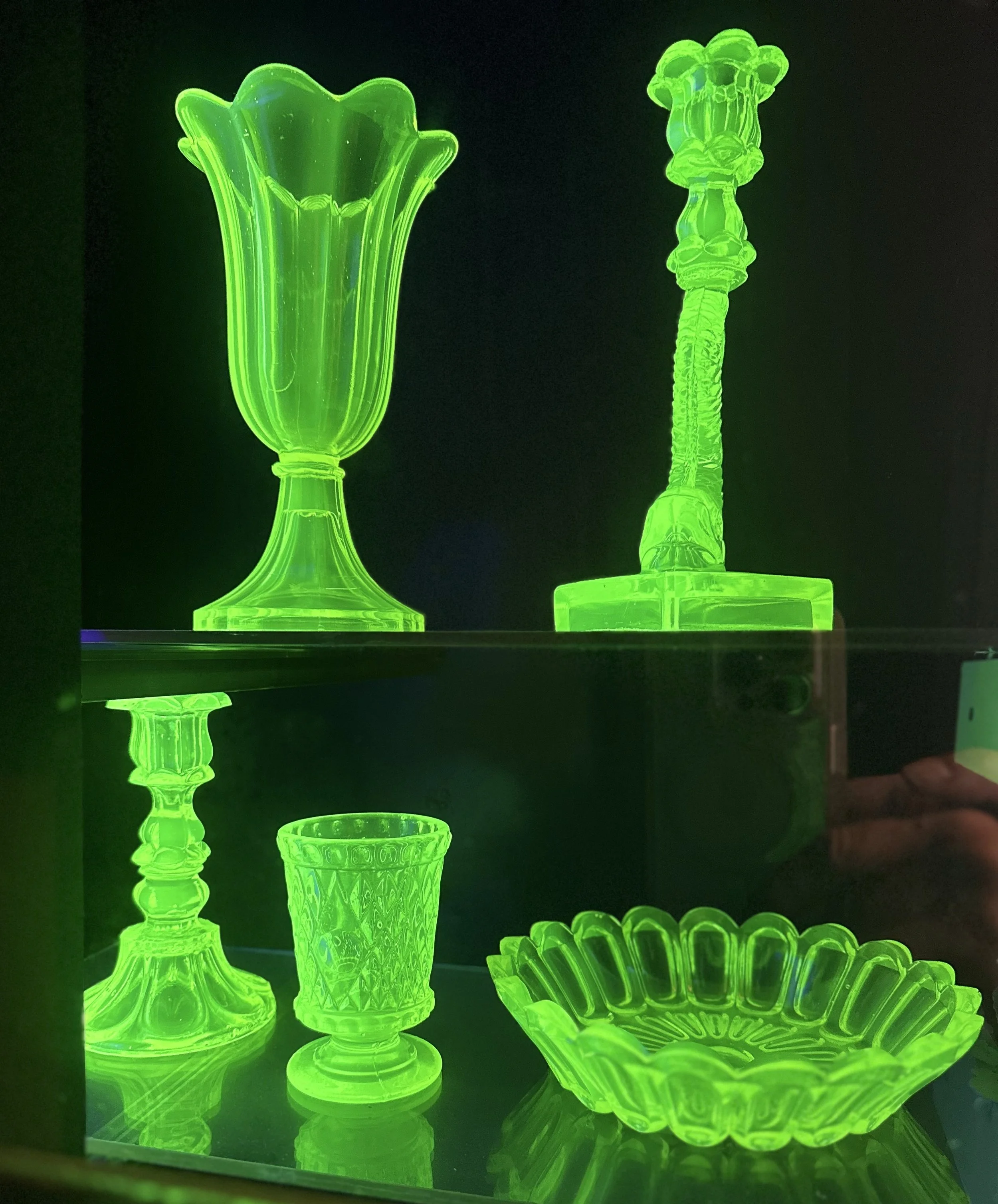
Under ultraviolet light, these pieces of Boston & Sandwich glass seem to undergo a Halloween-like transformation, fluorescing an eerie green.
The secret ingredient is uranium. Long before it became associated with atomic energy, nineteenth-century glassmakers added uranium compounds to create beautiful yellow and yellow-green glass. The Boston & Sandwich Glass Company was among them, producing uranium glass dolphin candlesticks and other wares.
The explanation is fluorescence. Ultraviolet light excites the uranium-containing glass, which gives off visible light. Although uranium is radioactive, the green glow we see here is a response to the ultraviolet light shining on it.
But the otherworldly glow of this glass fascinated people long before today’s blacklights were invented. In 1897, British chemist and photographer Thomas Bolas described a beam of light passing through uranium glass as looking like “thick green smoke in a clear medium.”
Who first thought of putting uranium in glass, and why?
The modern story reaches back to the Berlin chemist who identified uranium oxide in the 1780s, Martin Heinrich Klaproth.* He suggested that its compounds could be useful for coloring glass and porcelain. At the time, the chief mineral source used was the ore pitchblende.
By 1831, a Bohemian glass factory was producing yellow-green, fluorescent glass, and other makers soon embraced its remarkable color. By 1849, English glassmaker Apsley Pellatt published a recipe calling for three pounds of uranium oxide in a six-hundredweight batch of glass. A small amount could make a striking difference.
The Sandwich connection extends to scientific research, too. In 1970, researcher Henry Faul reported that the Sandwich Glass Museum was among the museums that had supplied uranium-glass samples to the University of Pennsylvania. His team wanted to measure more accurately the rate at which uranium-238 undergoes fission. When a uranium atom splits, the fragments leave microscopic tracks inside the glass. By studying these tracks in samples of known age, researchers hoped to better understand the process and improve methods for dating other glass.
Beautiful color, a ghostly glow, and microscopic traces of passing time—all in one display.
* The story may go back much further. In a 1948 article in the history-of-science journal Isis, Earle R. Caley argued that a Roman mosaic dating to around AD 79 contained glass intentionally colored with a uranium mineral. The evidence isn’t conclusive, but it raises the intriguing possibility that uranium glass has a much longer history.