
Is this older than the Revolution? A Fresh Look at a Hoxie Family Flask
We thought this powder flask from the Hoxie collection dated to the nineteenth century. A visiting historian gave us reason to think again.
When Revolutionary War historian and curator Phil Mead spotted it on display this summer, he contacted us with an intriguing suggestion: it could be much older, perhaps made around 1740.
The clues are in its construction. Its pear-shaped body is made from two sections of horn, joined with metal edging. Brass fittings include a nozzle and a spring-operated mechanism to control the release of gunpowder. Four small loops likely held a carrying cord or strap. These features resemble European hunting and sporting flasks of the mid-1700s, possibly French.
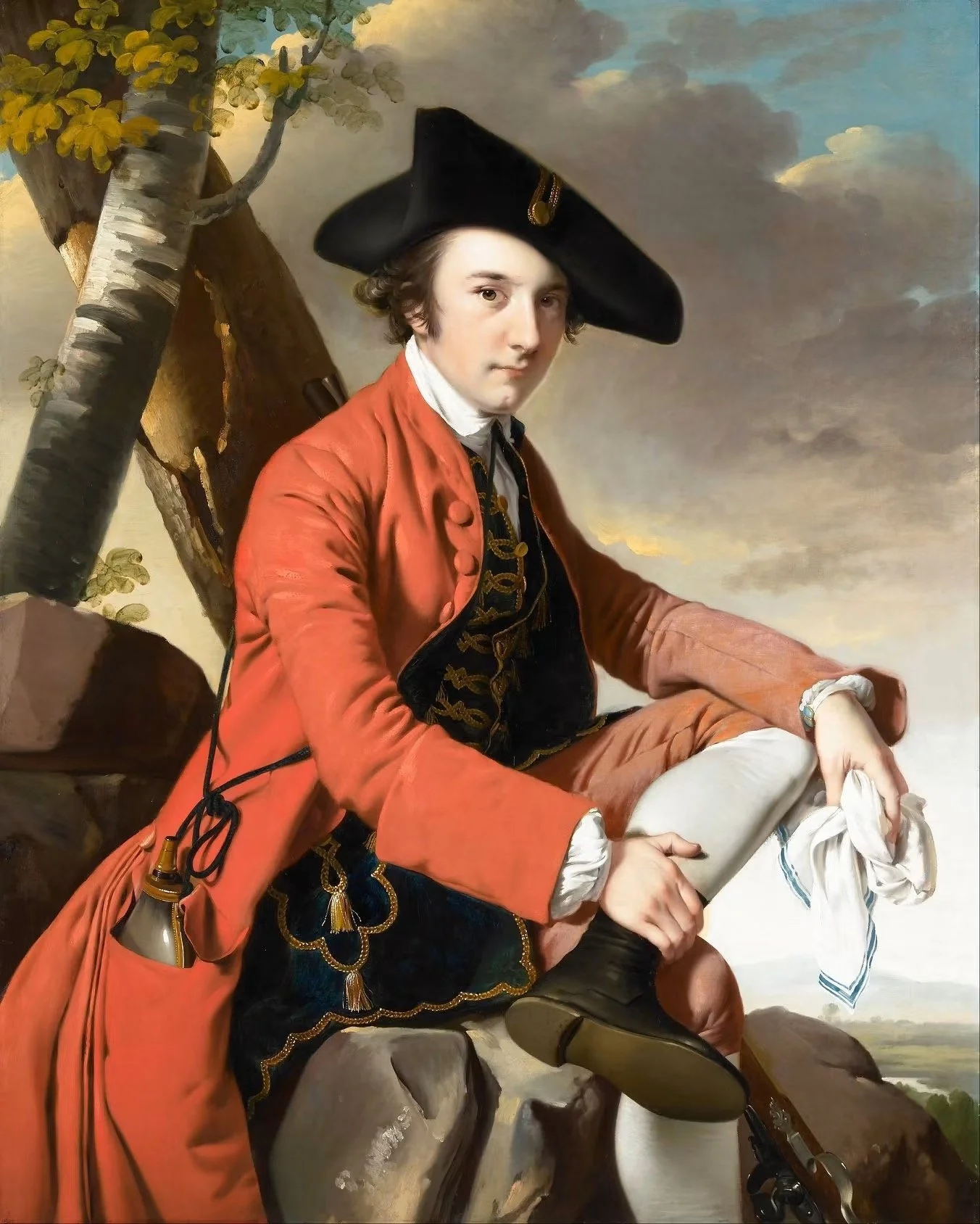
Portrait of English artist Joseph Wright of Derby (detail) by Fleetwood Hesketh, 1769, Walker Art Gallery, Liverpool, England, showing a similar flask in use.
How did this one reach the Hoxie family? Mead wondered whether a Hoxie might have captured it somewhere. That is a tantalizing possibility but, unfortunately, we have no clues to suggest who carried it, where it came from, or how the family acquired it.
As we continue to examine our collections in the context of America’s 250th anniversary, this flask invites us to consider the connections between Europe and everyday life in colonial and Revolutionary America. If it dates to around 1740, it was already decades old when independence was declared. How it reached Sandwich, and whose hands it passed through before joining the Hoxie collection, remains a story to uncover.
