
The Fight for Freedom
On October 16, 1859, abolitionist John Brown and Twenty-one followers—five Black men and sixteen white men—attacked the federal armory at Harpers Ferry, hoping to seize weapons and launch an uprising against slavery. Ten raiders were killed, and Brown and six others were tried, convicted, and executed by the state of Virginia. The raid failed but it intensified the conflict over slavery that was dividing the nation.
This 1866 print in the Sandwich Historical Society’s collections depicts a later moment in that struggle: Abraham Lincoln reading a draft of the Emancipation Proclamation to his cabinet on July 22, 1862, with the Civil War underway.
Engraved by Alexander Hay Ritchie after Francis Bicknell Carpenter’s painting, the scene looks solemn and orderly. But Cabinet members disagreed about emancipation and its consequences, and Secretary of State William Seward urged Lincoln to wait for a Union military victory before announcing it.
When the proclamation took effect on January 1, 1863, it declared freedom for enslaved people, but only in states that had seceded from the Union and those parts of the Confederacy that were then under Northern control. It did not end slavery throughout the country, but it made emancipation an explicit Union war aim.
Published after the war and Lincoln’s assassination, this print helped preserve one aspect of the fight for emancipation. Not visible in this print are the enslaved people pursuing their own freedom, abolitionists organizing against slavery, and Black soldiers fighting for the Union.
As we continue to reflect on America’s 250th anniversary, this image invites us to consider the struggle that lay between the Declaration’s promise of equality and the efforts to make it a reality.
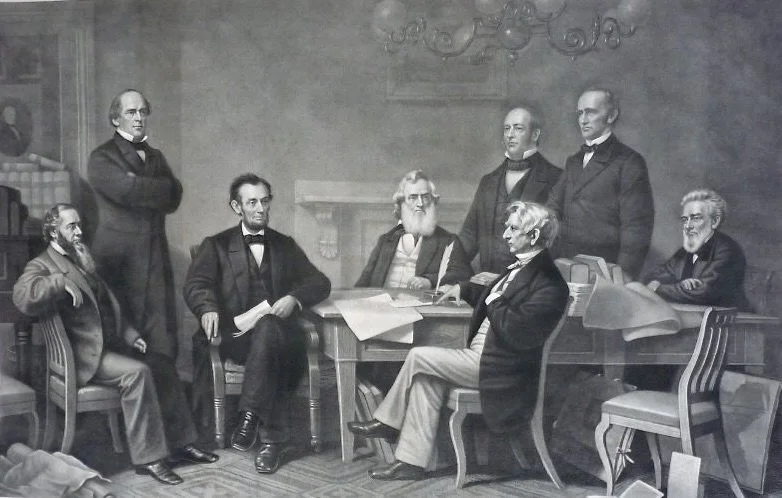
Pictured: (L-R) Edwin M. Stanton, Secretary of War; Salmon P. Chase, Secretary of the Treasury; Abraham Lincoln, President; Gideon Welles, Secretary of the Navy; Caleb B. Smith, Secretary of the Interior; William H. Seward, Secretary of State; Montgomery Blair, Postmaster General; Edward Bates, Attorney General
