
A SOLDIER’S POCKET DIARY
The Civil War
in George H. Freeman’s Words
APRIL–JULY 1861
In April 1861, George H. Freeman (1838–1908) of Sandwich, Massachusetts, volunteered for three months of military service with the New Bedford City Guards, a Massachusetts militia company. He kept a pocket diary during his service. His entries take us from the first days of the Civil War to Fort Monroe, where people escaping slavery sought refuge.
Explore the diary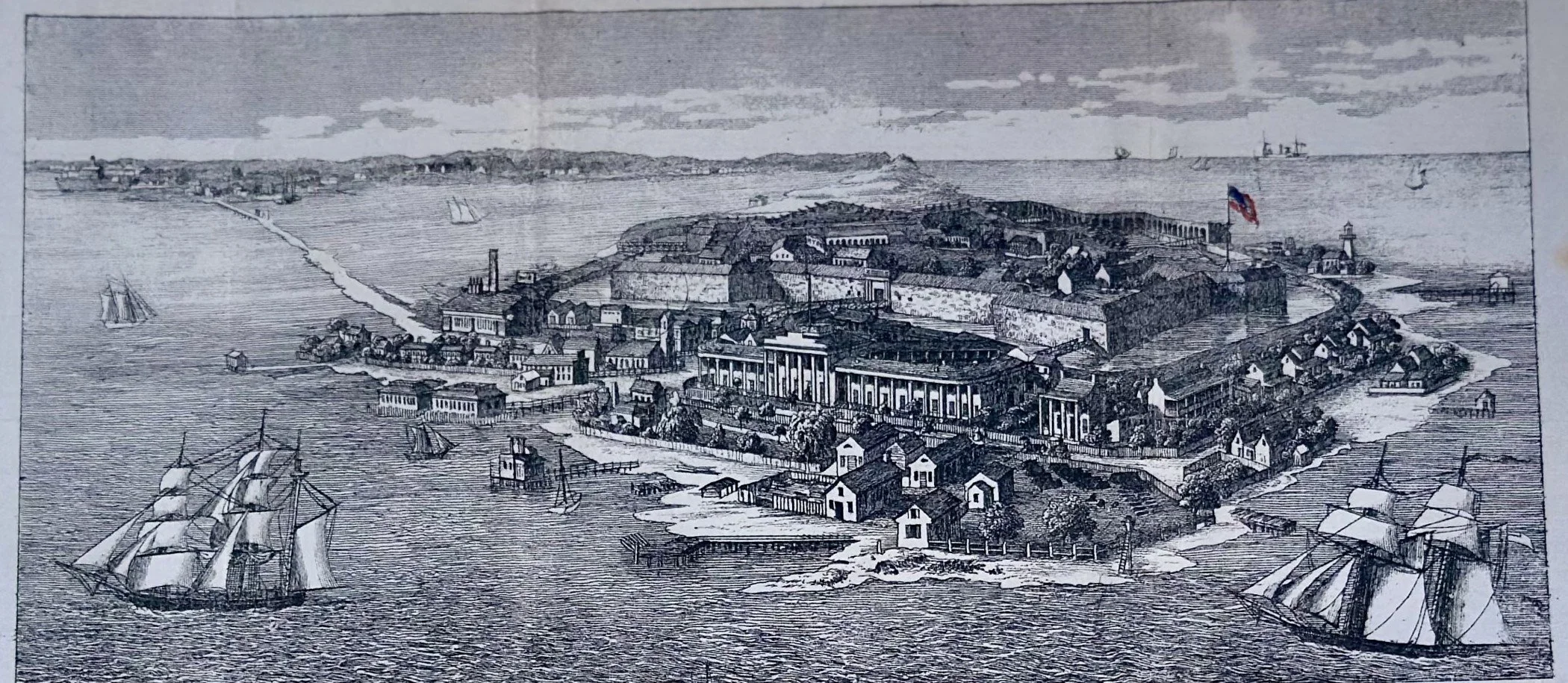
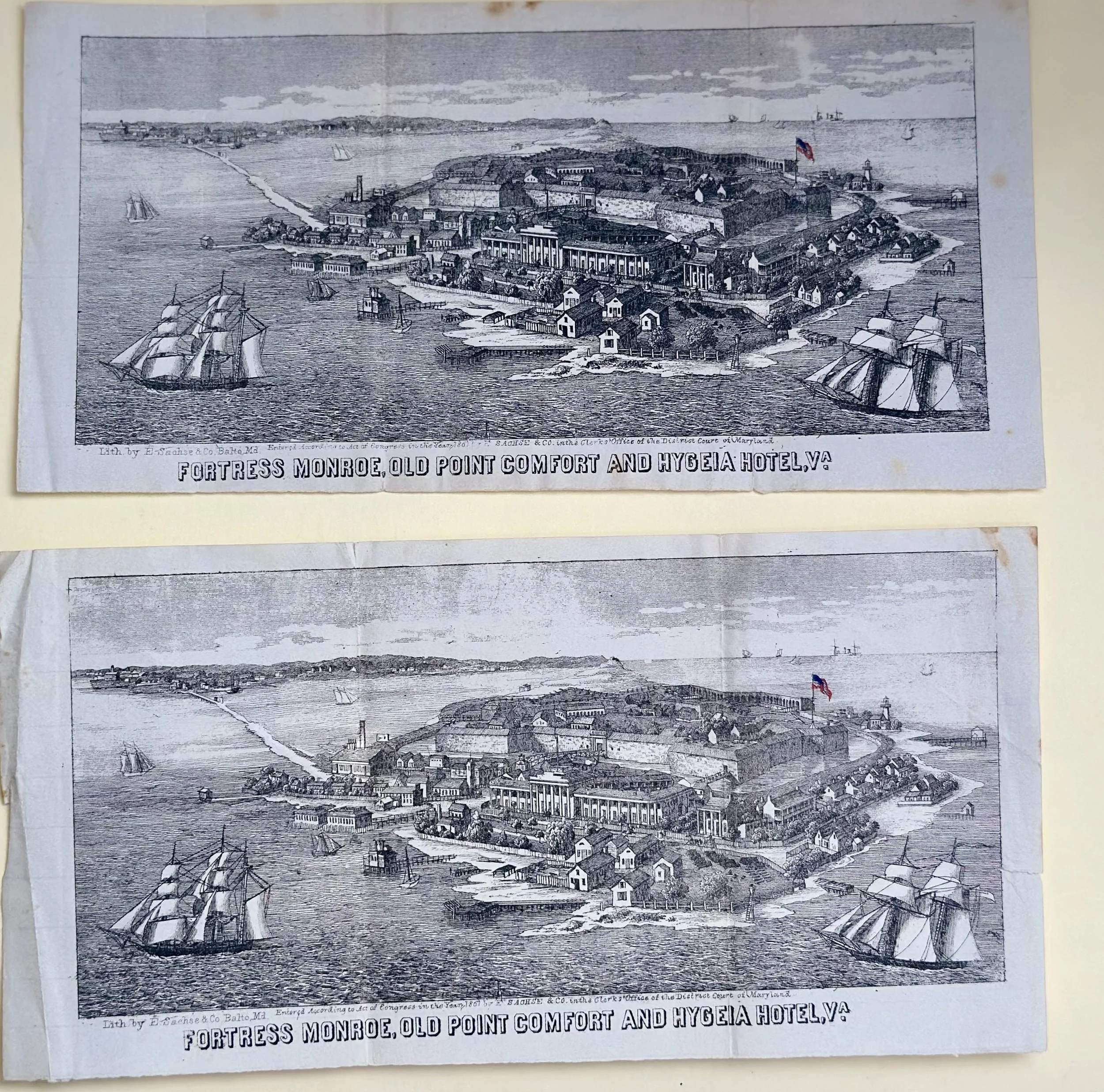
1. Fort walls
On his first night of guard duty, Freeman records men posted on the outer parapets. Read April 22 ↓
2. Hygeia Hotel
The long colonnaded building in front of the fort was the Hygeia Hotel. Print description, The Huntington ↗
3. Narrow approach
In his May 5 letter home, Freeman points to the narrow strip of land when explaining why he thought the fort could be held. Read the letter ↗
APRIL 1861
The Civil War begins
Beginning with South Carolina in December 1860, Southern states seceded from the United States to protect slavery. In April 1861, the confrontation over Fort Sumter in Charleston Harbor turned the secession crisis into war. Within days, George H. Freeman of Sandwich was on his way to Fort Monroe, Virginia. Fort Sumter National Historical Park ↗
APRIL 12
Confederates fire on Fort Sumter
Confederate forces opened fire on the U.S. garrison in Charleston Harbor. The bombardment began the Civil War. Fort Sumter history ↗
APRIL 15
Lincoln calls for troops
President Abraham Lincoln called for 75,000 members of state militias to serve for ninety days. Lincoln’s proclamation ↗
APRIL 17
Freeman joins the City Guards
In his diary, Freeman records joining the New Bedford City Guards and leaving Boston that evening. Read Freeman’s entry · IMG_0626.jpeg ↓
Fort Monroe stays in Union hands
Why the fort was built
After the War of 1812, the United States strengthened its coastal defenses. Work on Fort Monroe began in 1819 and was largely complete by 1834. Enslaved men helped build the stone and brick fort at Old Point Comfort, where it guarded the entrance to Hampton Roads and the waterways inland. Fort Monroe National Monument ↗
A Union post in Confederate Virginia
The U.S. Army already held Fort Monroe when the war began. Virginia’s convention voted to secede on April 17, and voters ratified the decision on May 23. The fort remained under Union control throughout the war. Its position helped the Union blockade Hampton Roads and gave people escaping slavery a place to seek refuge. Lincoln’s account of Virginia’s secession ↗ Fort Monroe proclamation ↗ Navy history of Hampton Roads ↗
George H. Freeman of Sandwich, Massachusetts, recorded arriving on April 20, just eight days after the first shots at Fort Sumter. Read Freeman’s arrival · IMG_0626.jpeg ↓
MAY 22–27, 1861
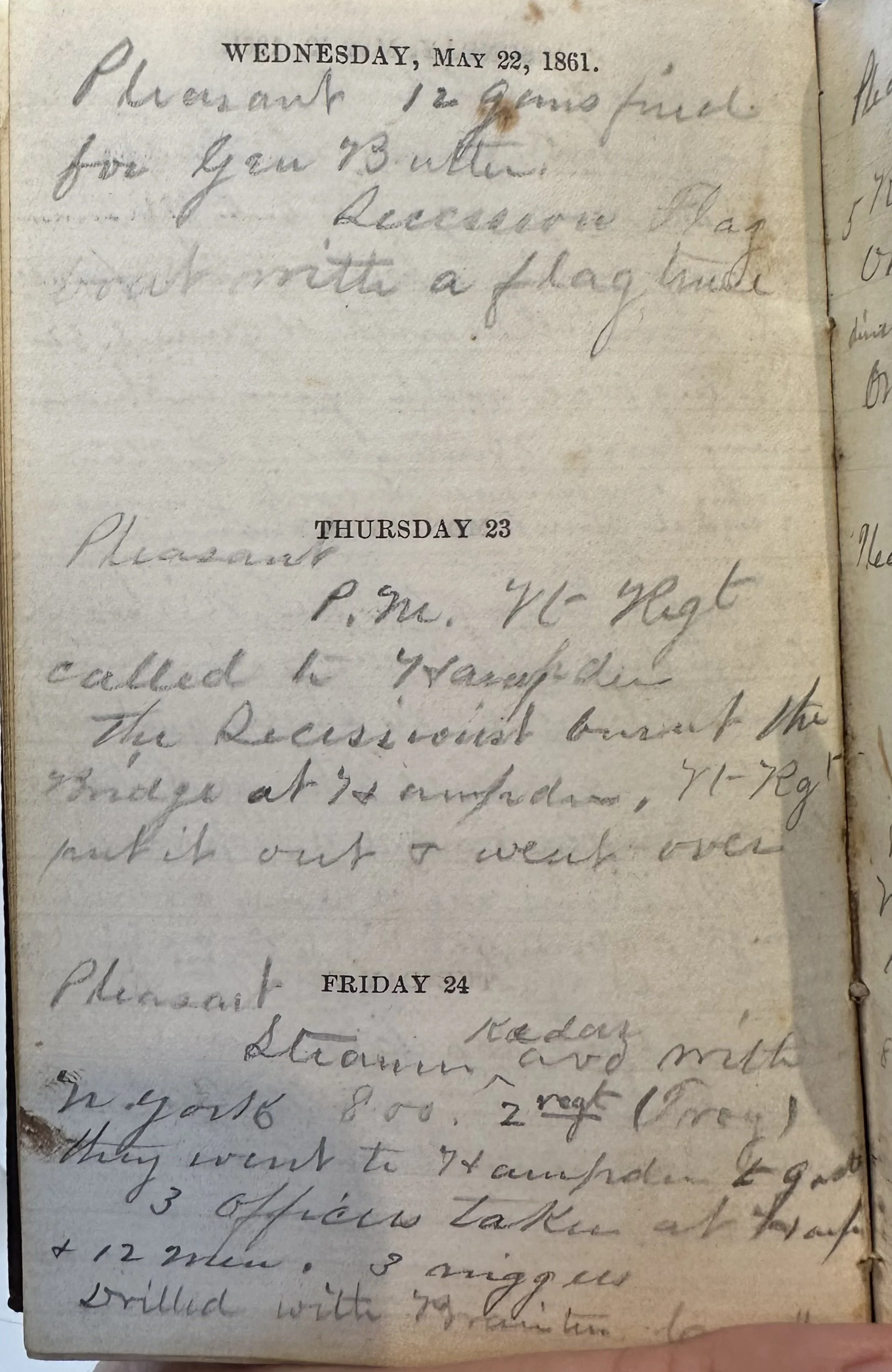
Came in for protection
On May 26, George Freeman wrote a single line about eight people who reached Union lines seeking protection. The day after, he recorded eight women and twenty-five children.
Three enslaved men, Frank Baker, Shepard Mallory, and James Townsend, had reached the Union pickets on the night of May 23. They were brought before General Benjamin Butler the following morning. Butler refused a Confederate demand to return them, reasoning that their forced labor could be used against the United States. More about Benjamin F. Butler · National Park Service ↗
Freeman’s May 24 entry mentions three Black people in a passage about events near Hampton. The number and timing fit. The diary gives no names, and the identification remains uncertain.
Edward L. Pierce, a private in Freeman’s company, later wrote about the arrivals in The Atlantic Monthly. He also recorded that eight people came to the fort on May 26.
“8 Slaves came in
for protection”George H. Freeman · May 26, 1861
A salute for Butler
Freeman records twelve guns fired for the general.
Three men reach Union lines
Baker, Mallory, and Townsend take the chance to escape.
Eight more seek refuge
Freeman and Pierce independently record eight arrivals.
Families arrive
Butler writes to Washington about caring for entire families.
APRIL 20, 1861
The ship that came back
Three days after Virginia’s convention voted to secede, the U.S. Navy evacuated Norfolk Navy Yard. Navy leaders feared Virginia forces would seize the yard, so they tried to remove what they could and destroy ships, guns, and supplies they had to leave behind. U.S. Navy account of the evacuation orders ↗ On April 20, Freeman went to the yard with his regiment to help. He notes the burning of a ship whose name is faint on the diary page. In a letter home, he names it as the Merrimack. Freeman’s letter in The Acorn, p. 10 ↗
Union forces burned and sank the frigate USS Merrimack as they abandoned the yard. The Confederates raised her and rebuilt her as the ironclad CSS Virginia. In March 1862, she fought USS Monitor at Hampton Roads.
Norfolk Navy Yard, then also called Gosport Navy Yard, stood in Portsmouth on the Elizabeth River, roughly 13 miles south of Fort Monroe in a straight line. The sites were connected by water. From the fort at the entrance to Hampton Roads, a ship crossed the harbor and continued up the Elizabeth River to the yard. 1861 map of Fort Monroe and Gosport Navy Yard ↗
How much of the Navy Yard was destroyed?
Freeman helped disable guns at the yard. His diary and letter record what the work looked like that night. The Navy’s account follows what the Confederates recovered after the Union withdrew.
The pocket diary
Freeman records spiking guns, rolling cannonballs into the dock, and the destruction of property. The entry compresses the night’s work into a few lines.
April 20 · IMG_0626.jpeg ↓The letter home
He names the ships and recalls a near miss when the Union frigate Cumberland almost fired on his ship. He tells his parents the dry dock was blown up and the yard completely destroyed.
Letter transcribed in The Acorn, p. 10 ↗What the Navy records
The dry dock survived, giving the Confederacy a place to repair large ships. The burned Merrimack was raised and rebuilt there as CSS Virginia.
Naval History and Heritage Command ↗When the harbor became a checkpoint
On April 23, Freeman recorded two shots fired to stop a steamer and wrote that its mail was taken. The steamer’s name is uncertain in the transcription. On May 3 and 6, he recorded shots fired at schooners. In his May 5 letter home, he described small schooners being taken and imagined what closing the waterways might mean for Norfolk. The April 30 blockade orders give readers a dated record to compare with the earlier diary entry and a way to see what the blockade meant for vessels carrying people, mail, and goods.
What were the Rip Raps?
On June 24, Freeman recorded firing from the Rip Raps. That was the name used for the small island fort across the channel from Fort Monroe. It was then called Fort Calhoun and was renamed Fort Wool in 1862. The museum’s 1861 lithograph shows Fort Monroe and the surrounding waters. In May 1862, after Freeman’s diary ends, President Abraham Lincoln came to Fort Monroe and helped plan the Union operation against Norfolk.
JUNE 10–18, 1861
After Big Bethel
The Battle of Big Bethel took its name from a church near Hampton, Virginia. Freeman’s diary traces what followed through news of the fighting, a funeral, and the return of a soldier’s body under a flag of truce.
On June 10, Union troops marched inland from Hampton and Newport News. Confederate troops had dug in behind Brick Kiln Creek near the church and drove back the Union attack. Freeman describes troops attacking a battery and records Lieutenant John Trout Greble’s death. His brief entry gives a view of what was being recorded at the fort that day. National Park Service battle summary ↗
Robert Knox Sneden’s map helps place Fort Monroe, Newport News, and Big Bethel on the peninsula. Its troop positions are dated April 1862. See the 1862 map ↗
June 10 · News of the battle
The entry records Greble’s death alongside the attack on a battery. Read June 10 · IMG_0635.jpeg ↓
June 12 · Greble’s funeral
Freeman notes the funeral and adds in the margin that Greble was taken to Baltimore. Read June 12 · IMG_0635.jpeg ↓
June 17–18 · A flag of truce
Freeman records the recovery of Major Theodore Winthrop’s remains on June 17. The next day, Company L escorted them to a boat. Read June 17 · IMG_0636.jpeg ↓ Read June 18 · IMG_0636.jpeg ↓
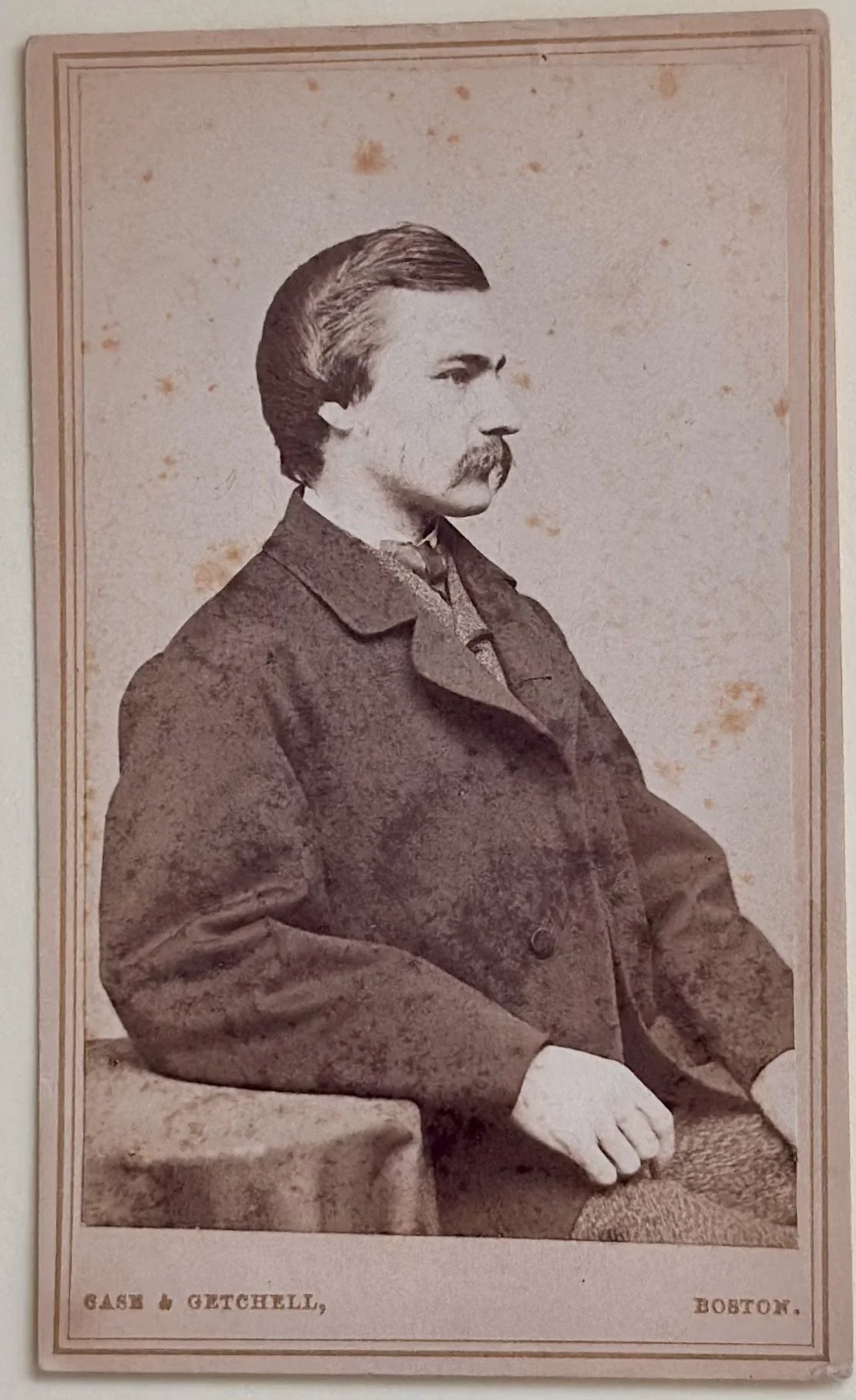
NEW BEDFORD CITY GUARDS
Three months away
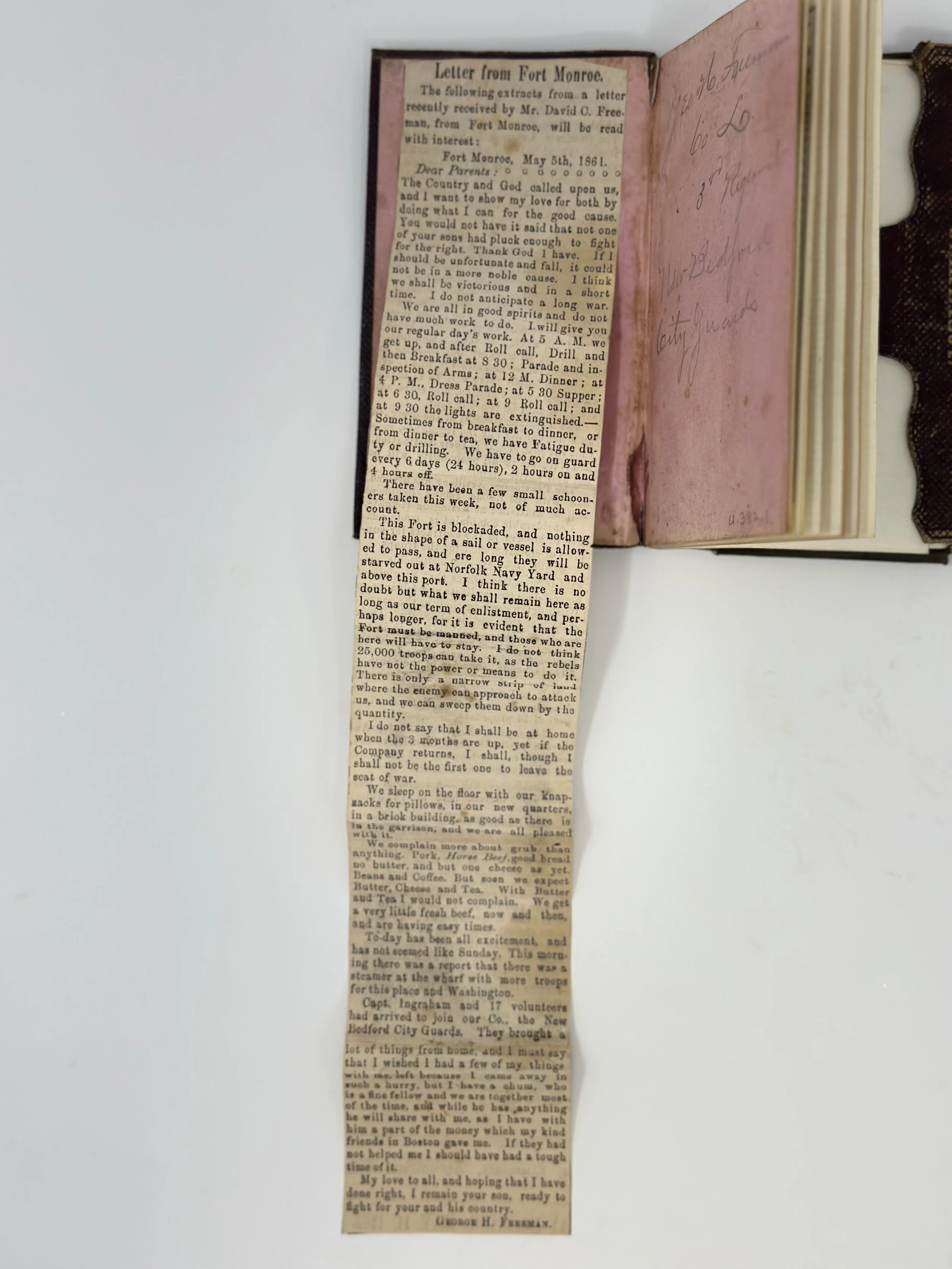
“I do not anticipate a long war,” Freeman wrote to his parents on May 5.
Freeman recorded joining the New Bedford City Guards on April 17, two days after Lincoln called for ninety-day militia service. His letter describes a day that began at five, guard duty in two-hour shifts, knapsacks for pillows, and a longing for butter and tea. On July 22, he recorded being mustered out. Three days later, he wrote that he was home.
Eight letters, fourteen papers
On May 5, the steamship Cambridge brought new soldiers to Fort Monroe. In the same entry, Freeman noted eight letters and fourteen papers, likely newspapers. He gave no names for the recipients. In a letter to his parents that day, he described the things the recruits brought from home and the belongings he had left behind in his hurry. A friend shared what he had, just as Freeman had shared money given to him by friends in Boston. In the back of the diary, Freeman kept track of letters and bundles alongside notes on a cannon and the cost of firing it.
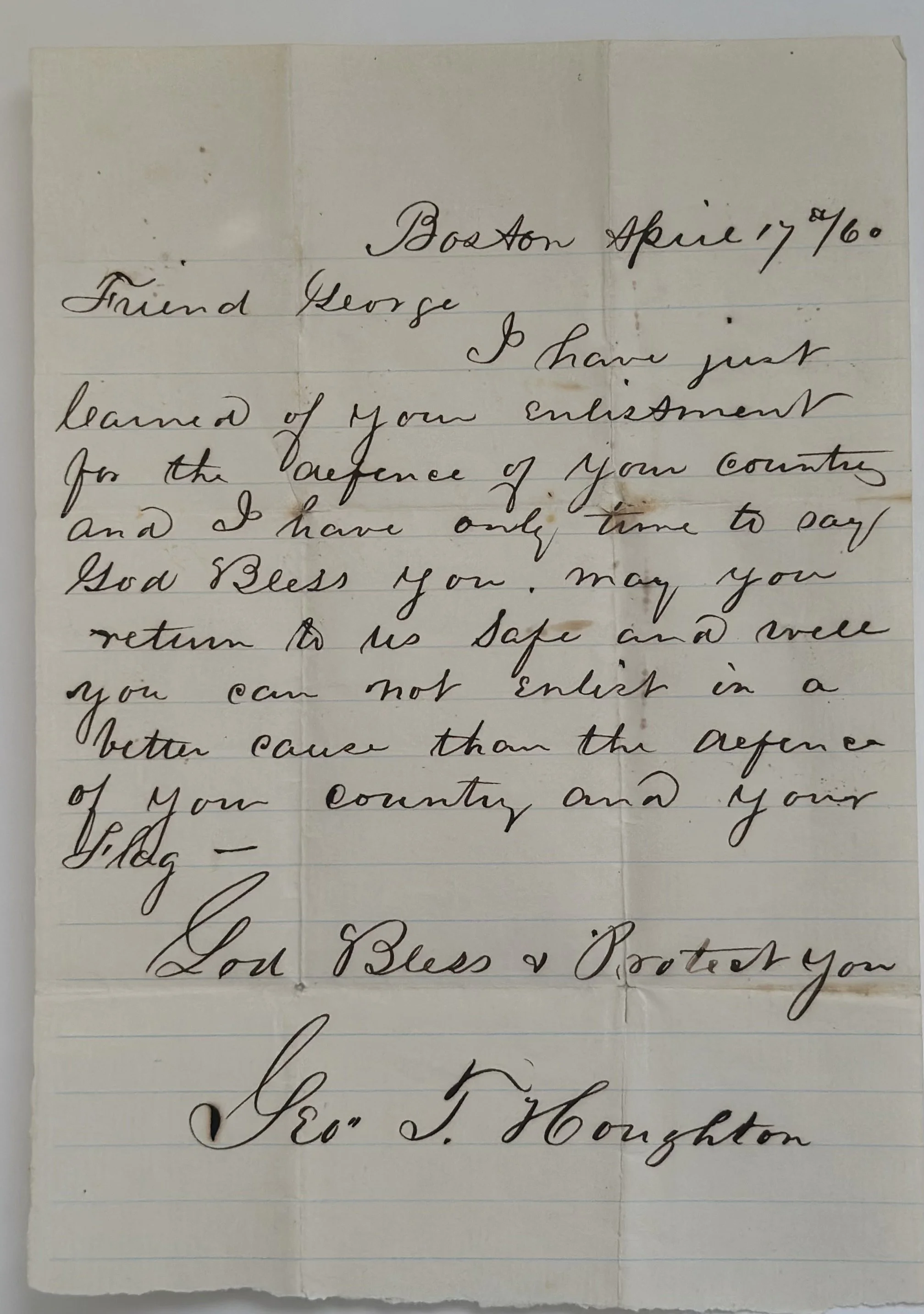
A flag from an earlier war
On July 3, Freeman recorded that a flagstaff went up and a flag was raised that had been used in battle in Mexico. On July 4, he recorded salutes from the fort and war vessels and a military review. His entries put an object he associated with an earlier war alongside the ceremonies of Independence Day in 1861. The flag’s identity and earlier history remain open questions.
SANDWICH, MASSACHUSETTS
From a glass town to war
Freeman’s Sandwich roots
George Henry Freeman was born in Sandwich on December 28, 1838, the son of David and Jane (Newcomb) Freeman. His father served as town clerk and treasurer. Dorothy G. Hogan-Schofield, a former curator at the museum, cites a local newspaper clipping that described Freeman as the first man from Sandwich to enlist in the Civil War. Dorothy G. Hogan-Schofield, The Acorn, p. 11 ↗
Two letters home survive as newspaper extracts transcribed by the museum. One describes the rough passage from Boston and the burning of the Navy Yard. The May 5 letter describes food, guard duty, and how a friend shared supplies at the fort. Freeman’s two letters, The Acorn, p. 10 ↗
Freeman’s life after military service
After his three months of service in 1861, Freeman settled in New Bedford. He married Clara Nye on October 2, 1865, and they had a daughter. He served on the New Bedford city council in 1875 and 1876. When he died in 1908, he was working as a clerk in the city auditor’s office. Dorothy G. Hogan-Schofield, The Acorn, p. 11 ↗
The town raises its own company
On April 20, the day Freeman records reaching Fort Monroe, Sandwich residents gathered at Town Hall after hearing of the attack on Massachusetts troops in Baltimore. They voted a $20 bounty for recruits. The company they raised, the Sandwich Guards, was led by Charles Chipman and later became Company D of the 29th Massachusetts. Freeman was already serving with the New Bedford City Guards. William F. Daley, The Acorn, pp. 2–3 ↗
Other Sandwich names in the roster
Stauffer Miller’s town roster lists George H. Freeman as a 22-year-old private discharged on July 22, 1861. It prints “5th MA, Co L.” The Massachusetts service register and Company L’s history place him in the Third Massachusetts. Sandwich roster, p. 3, no. 119 ↗ Massachusetts service register, vol. 1, p. 163 ↗ Company L roster, p. 30 ↗
The town roster also lists George H. Clark in Company H of the 54th Massachusetts and records Sumner B. Fish as missing at Bull Run on July 21, 1861. Freeman’s diary records his own muster-out the following day. Sandwich roster, p. 2, no. 61 ↗ P. 3, no. 110 ↗ Freeman’s July 22 entry ↓
Civil War objects from our collection
Sandwich Wide Awakes lantern
Sandwich glassworker Charles Pope carried this lantern during Abraham Lincoln’s 1860 presidential campaign. It brings the politics of the year before Freeman enlisted into the story.
See the lantern · Sandwich Historical Society ↗Portrait of Major Charles Chipman
Chipman worked as a machinist at the Boston & Sandwich Glass Company before he led the Sandwich Guards. After his death in 1864, veterans helped purchase the oil portrait and presented it to his widow and children.
See the portrait · Sandwich Historical Society ↗ History of the portrait · The Acorn, p. 4 ↗Augustus Holway’s Civil War knapsack
In his May 5 letter home, Freeman wrote that the men slept on the floor with their knapsacks for pillows. This knapsack belonged to another Sandwich soldier, Private Augustus Holway of Company D, 45th Massachusetts Infantry.
See Holway’s knapsack · Sandwich Historical Society ↗Read Freeman’s May 5 letter ↗Proclamation for a Day of Fasting, Humiliation, and Prayer
Massachusetts Governor John A. Andrew issued this proclamation on March 1, 1865. It shows how Massachusetts marked the war at home, nearly four years after Freeman recorded his first days at Fort Monroe.
Find the proclamation in History Corner ↗Women’s Relief Corps photograph, 1914
Members of the women’s auxiliary to Sandwich’s Grand Army of the Republic post gathered around a decorated truck on Jarves Street, likely for a Memorial Day or patriotic parade. The truck bears the name of Charles Chipman and the number 132.
See the photograph · Sandwich Historical Society ↗Explore Civil War history in Sandwich
Sandwich Town Archives
The archives at Sandwich Public Library hold Freeman family files and town meeting records. Their digital repository also has a guide to Stauffer Miller’s research on Sandwich soldiers and sailors.
Explore the Town Archives ↗Stauffer Miller Papers and roster ↗Town Hall and Eaton Square
Sandwich residents met at Town Hall in April 1861 to raise a company. The Civil War memorial plaque inside names 294 soldiers and sailors. Outside, the Soldiers’ and Sailors’ Monument was dedicated in 1911 and given by William Eaton, who had worked at the Sandwich glass factory.
Town Hall history ↗Civil War memorial plaque ↗Soldiers’ and Sailors’ Monument ↗Wilson Burial Ground
Joseph Wilson, a Black Union veteran, enlisted in New Orleans in 1862. His unit later became the 73rd United States Colored Infantry. After the war he lived in Sandwich, where his military headstone still stands near Quaker Meeting House Road.
Joseph Wilson and his burial site ↗POCKET DIARIES AND LETTERS
Who gets to tell the war?
A few lines a day
Freeman took a commercially printed pocket diary into the war. A spread gives three dates to a page, and the back has room for memoranda. He used that space to tally letters and parcels and to note the weight of guns and shells. A book small enough to carry also shaped what he could fit on the page. See the daily entries ↓ Read the memoranda in the transcript ↓
Other soldiers carried similar books. Virginia Tech holds a Denton & Wood pocket diary, from the same publisher as Freeman’s, that Confederate soldier James A. Branch reused for his 1865 entries. The University of Delaware holds a Massachusetts infantryman’s diary with printed tables for postage and rail travel, a packing list, and cash accounts. Branch diary, Virginia Tech ↗ Pocket diary, University of Delaware ↗
From writing home to writing the president
Freeman’s letters to his parents appeared in a local newspaper. Two years later, another man connected to New Bedford, James Henry Gooding of the 54th Massachusetts, wrote to the New Bedford Mercury about his regiment’s service. He also wrote to President Lincoln to challenge unequal pay. Freeman’s letters, The Acorn, p. 10 ↗ Gooding, National Park Service ↗
In May 1861, Freeman recorded people reaching Union lines for protection. In 1863, Gooding wrote as a Black soldier demanding that the Union recognize his service on equal terms. Their words let us ask how the war changed who could serve and what soldiers could ask of the country they served. Freeman’s May 26 entry ↓ Gooding’s letter to Lincoln ↗
What can the diary tell us?
Freeman’s pocket diary records what one private noticed, heard, and thought worth writing down during three months of service. A few lines can document an event and still leave much of its story open.
Whose names are missing?
On May 26, Freeman counted eight people who came to the fort for protection. The entry leaves their names, what they experienced on the way, and what happened to them afterward unknown. His May 24 reference to three Black people may relate to the men who came before Butler. Timing and number make that a plausible reading, and the entry leaves their identities open.
Read May 26 ↓Compare the accounts of the arrivals ↓What did Freeman see himself?
The June 10 entry records a Union attack and Lieutenant Greble’s death. It leaves open where Freeman was during the fighting and how he learned the news. The diary and the battle record answer different questions.
Read June 10 ↓Read the Big Bethel account ↑When does his account end?
Freeman’s dated entries end in July 1861, after he returns home. His diary leaves the later war and the long-term lives of the people who sought refuge at Fort Monroe to other sources.
Read his return home ↓THE POCKET DIARY
Read the diary
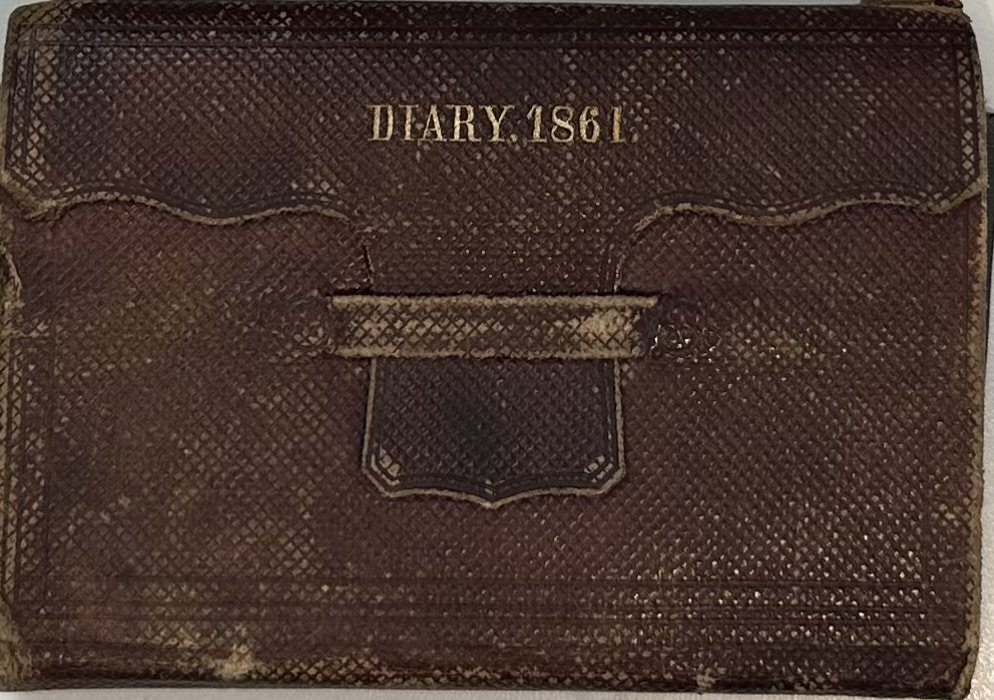
Browse the entries by month or search the transcript. The diary preserves historical language, including racial slurs. Brackets indicate editorial notes and uncertain readings. Crossed-out writing appears as strikethrough.
Reading the pencil entries
Freeman wrote in pencil, and some of the marks are now faint enough to make individual letters hard to distinguish. A pencil was likely convenient for a soldier keeping a pocket diary. It was easy to carry and ready to use when he had a moment to write, without a separate bottle of ink. The transcript marks doubtful readings in brackets and uses [illegible] where the handwriting cannot be read confidently. Writing in the field during the Civil War ↗
Acknowledgments
We used AI to help transcribe the diary, develop the historical narrative, and build this website.
Inspired in part by Exploring Little Compton’s Past, a website presenting seven interactive projects built from the town’s historical records, including Revolutionary War pension files, a farm account book, the 1850 census, a diary, and an architectural survey. The website was shared by Steven Lubar, curator at the Little Compton Historical Society in Little Compton, Rhode Island.